


How Should You Hold a Flute? Hand Position Problems and Simple Fixes

Good hand position makes a big difference to how comfortable and easy the flute feels to play. After many years of teaching, I find the same few hand position problems come up again and again, whether I'm working with a young beginner, an adult beginner or an experienced player returning to the flute.
The aim isn't to make all player's hands look exactly the same. Hands vary enormously in size, shape and flexibility. What we're looking for is a position that lets the flute feel balanced, the fingers move freely, and the hands and wrists stay as relaxed as possible. Tension makes playing harder and can also restrict finger movement.
Here are five questions I'm often asked about flute hand position, with some simple fixes you can try.
1. Where should the right thumb go?
The right thumb is one of the most common hand position problems I see, and it has a big effect on how well the flute balances.
For most players, the thumb sits roughly underneath the first finger of the right hand. Some players find it more comfortable slightly higher, or between the first and second fingers, and that's fine. What causes problems is a thumb that has moved too far forward. The hand then becomes squashed and locked, and it's much harder to control the balance of the flute.
It also helps to understand what the thumb is actually doing. It isn't there to hold the flute up from below. Instead, it gently pushes the flute forward, working with the base of the left index finger to keep the flute balanced against the chin. The thumb itself should have a relaxed curve.
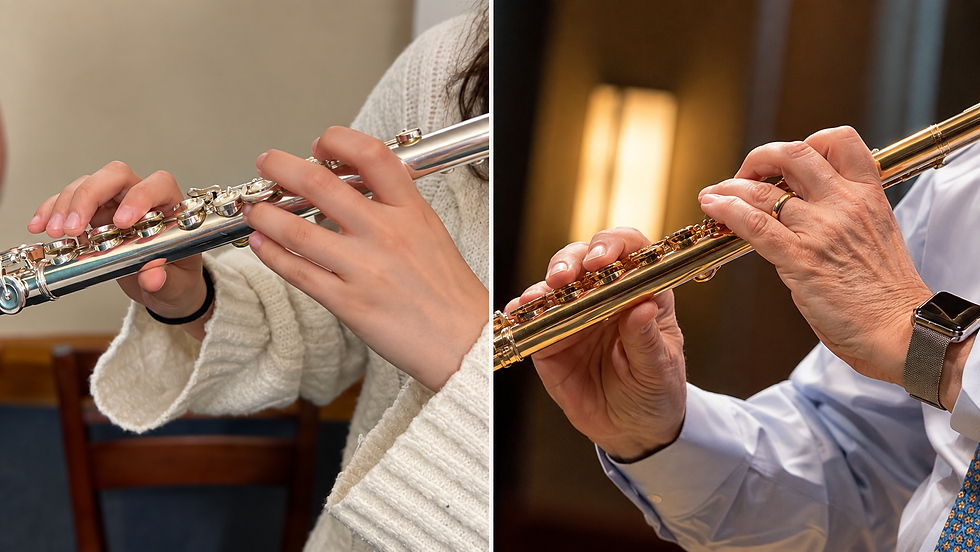
2. What should the left hand look like?
The left hand should have a naturally rounded shape, with some space inside the hand rather than gripping tightly around the flute.
The flute rests just above the bottom knuckle of the left index finger. The left thumb operates the thumb keys, and you can use the side of the thumb, gently rounded rather than bent back. What the left thumb shouldn't do is hold up the weight of the flute. Many beginners think this is its job, but if the left thumb supports the flute, the whole hand becomes tight and the flute tends to move whenever the thumb lifts for certain notes.
The left fingers should fall easily onto the keys without being stretched or twisted, and the wrist should stay relaxed rather than locked.

3. Should flute fingers be curved or straight?
In general, flute fingers work best with a gentle, natural curve. This shape gives the fingers both flexibility and strength.
Very flat fingers make movement less efficient and can create tension through the hand and wrist. At the other extreme, the fingers don't need to be held in a rigid curve either. Think relaxed and rounded rather than flat or stiff.
The fleshy pad of each finger should sit on the key. Flat fingers are often the reason fingers end up hanging over the keys, which makes quick and accurate movement much more difficult.
The right little finger also works best with a gentle curve, rather than being straight and locked.
This is one of the easiest hand position problems to spot in a photo or mirror.

4. Are my fingers lifting too far from the keys?
It's very common to see fingers flying high above the keys, particularly with beginners.
The further a finger moves away from a key, the further it has to travel to come back again. Keeping the fingers close to the keys makes every movement smaller and more economical.
This doesn't mean pressing the keys down heavily. The fingers should stay relaxed and ready to move, just without lifting so far.
If you're not sure what your own fingers are doing, try watching in a mirror or making a short video of your hands while you play. Extra finger movement is often much easier to notice when you can see it.

5. Why does my flute keep slipping?
If the flute feels as though it's constantly rolling or slipping, the answer is not to grip it more tightly.
It's better to think of the flute as being balanced rather than held. Three points of contact make this balance possible: the chin, the base of the left index finger and the right thumb.
The right little finger shouldn't act as the main support. If you rely on it to keep the flute steady, you'll lose that support as soon as it lifts for a note, and the flute will slip.
This is another reason the right thumb matters so much. If it has moved too far forward under the flute, it's much harder to control the balance of the flute without gripping.
When the flute is well balanced between these three points, it should feel stable rather than as though it is rolling or slipping, leaving the fingers free to move over the keys instead of helping to hold the instrument in place.
Everyone's hands are different
These are useful general principles, but there's always room for individual variation. Hand size, finger length and joint flexibility all affect what feels comfortable, so the ideal position won't look exactly the same for every player. The aim is always a position that lets the hands work freely without strain or tension.
Flute hand position FAQs
Should my hands feel completely relaxed when I play?
Relaxed doesn't mean floppy. Your fingers still need enough control to operate the keys accurately, but you should avoid gripping or stiffness. Ideally, the fingers, hands and wrists should feel free to move.
What if I have hypermobile fingers or thumbs?
Players with very flexible joints may need to adapt some of the usual hand position advice. Rather than forcing a finger or thumb into a particular shape, aim for a comfortable, neutral position and avoid joints locking or collapsing backwards. If a particular position causes discomfort, it may need adjusting to suit your hands.
What should I do if my hand position feels uncomfortable?
Discomfort shouldn't simply be ignored. Check whether you're gripping the flute, stretching further than you need to, or locking the wrist or fingers.
Because everyone's hands are different, small adjustments may be needed to find the position that works best for you. If you're a student, ask your teacher to look at your hands while you play. A mirror or short video can also be very useful for checking what your hands are actually doing. If pain continues, it's worth seeing a physiotherapist or other health professional.
A comfortable hand position makes playing easier
Good flute hand position isn't about achieving a perfect-looking pose. It's about finding a balanced position that lets the fingers move easily and freely.
Often a small adjustment to the thumb, wrist or fingers is all it takes to make the flute feel easier to play.
A tip for teachers: try taking a photo of your student's hands while they play, then ask them what needs fixing. I call this game FIXAPIC, and students are often surprisingly good at spotting the problems themselves!
More practical ideas for flute teachers
You are welcome to join my newsletter for teaching tips, articles, workshops and new resources.
Karen North is a music teacher, book author and publisher. She is passionate about bringing music into the lives of children and adults and has enjoyed working in music education for over 40 years.
Karen is the author of the popular method books "The Young Flute Player" and has commissioned over 100 new works for intermediate flute repertoire in "Lyrical Flute Legends" , "Lyrical Flute Encores" , "Inspiring Flute Solos." and Inspiring Flute Duets as well as an exciting collection of 40 new easy pieces in, "Lyrical Flute Miniatures".
Karen has written two books of music games (with printable templates) "Fun & Games for Music Lessons", "More Fun & Games for Music Lessons 2" and has recently worked with specialist consultants on repertoire books for Violin, Clarinet and Saxophone.
Karen also organizes an international FLUTE CHAMPIONSHIP each year, to give students of all ages and abilities an opportunity to submit a video performance to an outstanding panel of judges. Her workshops for teachers are enthusiastically received and she also offers an online mentor group for flute teachers.


